The Filipino family is not being treated as an abstract idea.
It is the family gathered around a meal. The family navigating bills. The parent trying to understand a child. The siblings who love one another but sometimes compete, resent, or misunderstand each other. The grandparents whose role extends beyond one generation. The household carrying grief, illness, separation, financial strain, or unresolved conflict.
And it is into those realities that the project hopes to help families hear Scripture.
A different question for a Bible scholar and a writer
For Ptr. Noli, that changed the nature of the writing itself.
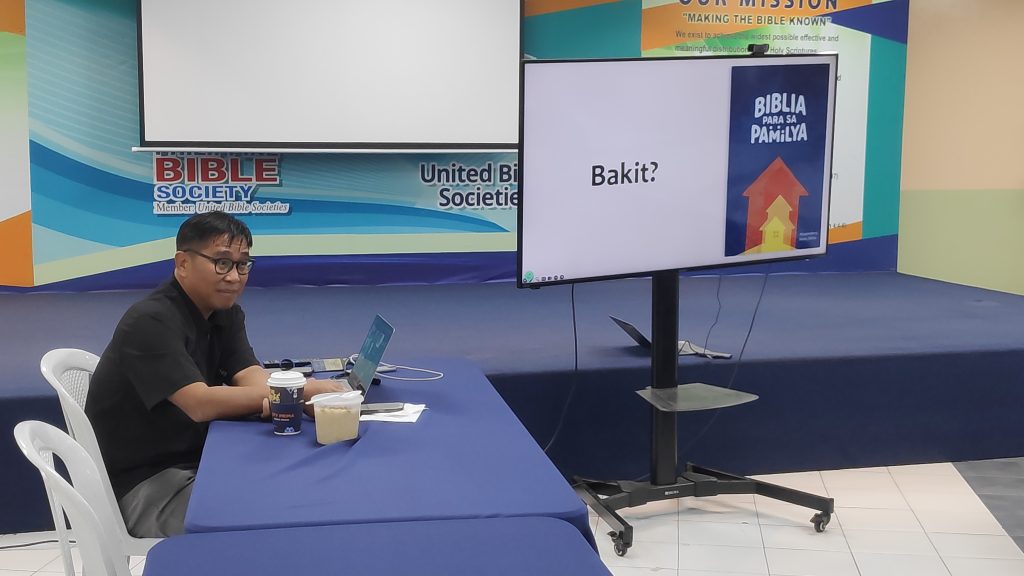
In academic or theological work, he explained, much of the effort naturally centers on studying the biblical text carefully and explaining it correctly. Those disciplines remain essential. But Biblia para sa Pamilya introduces another question:
“How will this help a family encounter the Word of God?”
For him, that makes the assignment both “challenging and beautiful.”
A writer must think deeply about Scripture, he said, but must also communicate its meaning simply and easy to understand. A child should be able to understand. So should a mother or father. So should a lolo or lola.
The aim is not to dilute Scripture, but to help an entire household recognize that the Bible has something to say within the circumstances of everyday life.
That concern becomes even sharper when Ptr. Noli thinks about families experiencing poverty or other forms of vulnerability.
He cautioned against romanticizing poverty or offering simplistic answers to difficult circumstances. Instead, he hopes families will discover that hardship does not diminish their dignity before God.
For a project intended to serve families with limited resources, that distinction matters.
The Family Bible is not being developed on the assumption that difficult problems can be resolved with easy religious answers. It seeks instead to place Scripture close enough to real experience that a family can wrestle with the Word of God in the midst of that experience.
When families see their own stories
As Ptr. Noli reflected on his work, one realization returned again and again: the families found in Scripture were not perfect families either.
There were conflicts. Separation. Suffering. Brothers and sisters who did not understand one another. Parents and children facing difficult circumstances.
Those biblical stories, he observed, can help contemporary families recognize that their own struggles do not put them outside the reach of God.
Sometimes, he said, ministry is not a matter of finding “perfect words” or “perfect responses.” It can begin by helping people discover that the Word of God speaks into their situation and that they are not alone.
That insight captures something important about the development of Biblia para sa Pamilya.
Contextualizing a Family Bible is not simply a matter of adding Filipino examples around a biblical text. It requires careful listening—to Scripture, certainly, but also to the circumstances in which Filipino families are actually living.
That is why the breadth of the writing assignments matters.
A conversation about money may become a way for a family to reflect on responsibility, anxiety, generosity, or conflict. A piece about an absent father or an OFW parent may give language to experiences that many children and parents find difficult to discuss. Material on aging parents or grandparents can address both honor and caregiving. Discussions of sibling rivalry, favoritism, family secrets, illness, loss, or reconciliation may open subjects that families often carry quietly.
The goal is not simply relevance for relevance’s sake.
As Ptr. Noli put it, biblical understanding should ultimately lead toward “transformation, toward compassion, toward deeper relationships with God and with one another.”
The quieter work behind the pages
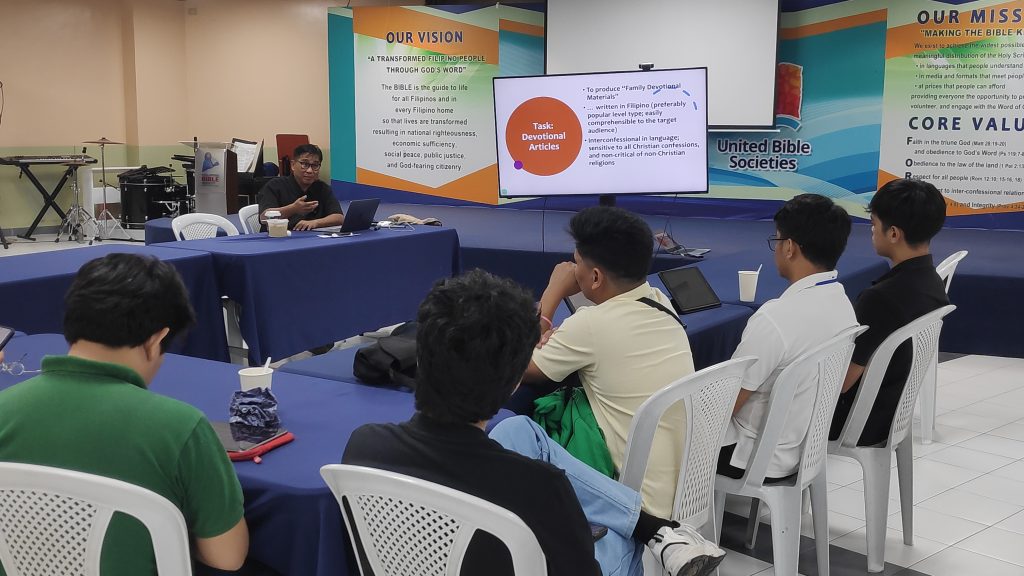
The February gathering was not the end of the content process.
The writers’ submitted articles and write-ups have now moved into review by translation and writing consultants.
It is a less visible stage of the project, but an essential one.
Before a family can open the finished Bible, there must be conversations about what should be addressed. Writers must research, reflect, and draft. Biblical material must be handled carefully. Filipino realities must be represented with sensitivity. Language must be understandable without losing substance. Articles must be reviewed. Translation, editorial judgment, and consultation must follow.
In other words, the Family Bible is being built not only through printing and distribution, but through the work that happens long before a book reaches the printing stage.
The collaboration of writers, Bible scholars, translators, and consultants signals the care being given to that process.
A resource meant to enter Filipino homes must be both biblically responsible and genuinely accessible to the people who will use it.
That takes time.
It also takes people.
Imagining the Bible inside a home
When Ptr. Noli imagines the finished Family Bible reaching its readers, his hopes are strikingly ordinary.
He imagines a mother or father finding encouragement.
A child discovering that God understands and loves them.
Family members reading together, talking together, listening to one another, praying together, and growing together.
His hope is not that the Bible will make families pretend their problems have disappeared. He described instead a hope that does not ignore difficulty, but enables people to face it in the light of God’s Word.
That distinction may be one of the clearest expressions of what Biblia para sa Pamilya is being developed to do.
A family struggling financially may still have bills tomorrow.
A relationship may still need reconciliation.
A parent may still be working far from home.
A household may still be grieving someone it loves.
But the Bible in that home can become a place where the family encounters Scripture together. Where a familiar struggle can lead to a conversation, a prayer, a question, or an encouragement that might otherwise never have been spoken.
This is the potential impact being built now, article by article and conversation by conversation.
Where the donor enters the story
For donors who first encountered this vision in November 2025, the progress since then offers a more tangible picture of what their generosity is helping make possible.
Support for Biblia para sa Pamilya is not only support for a physical book at the end of a production line.
It helps make possible the process behind that book: bringing contributors together, developing culturally grounded content, engaging biblical scholarship, writing and rewriting, translation, consultation, editorial review, and eventually preparing a resource families can actually use.
Ptr. Noli expressed that connection to supporters in personal terms.
Donors, he acknowledged, may never meet every family who eventually reads the Bible. They may never hear the conversations that take place during a family devotion or know about the evening when someone opens a page while facing a difficult season.
But, he told them, “your generosity will become part of those moments.”
That is perhaps the most fitting way to understand this stage of the project.
In November 2025, donors were asked to see a vision.
In February 2026, writers gathered around that vision and began giving it language, context, reflection, and substance.
Now, those contributions are being reviewed and refined by the people responsible for helping ensure that the eventual Family Bible is clear, responsible, and faithful.
There is still work ahead.
But the movement is visible: from vision, to collaboration, to writing, to review—and, in time, toward Filipino families opening these pages in their own homes.
Each article being refined today is part of preparing for that future moment: a parent reading with a child, siblings discussing a passage, a family bringing a difficult question into the light of Scripture, or a household finding words for prayer in a season of uncertainty.
That is the work donors are helping move forward.
And as Biblia para sa Pamilya continues to take shape, continued support helps carry the project through the careful work still required before the vision first shared in November becomes a Bible that Filipino families can hold, read, discuss, and experience together.







Leave a Reply